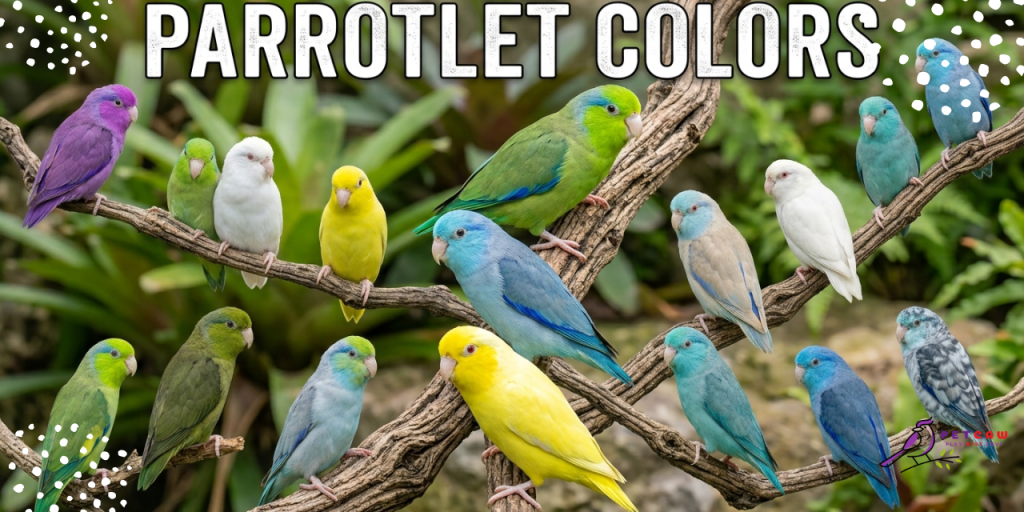
Understanding parrotlet colors is far more than an exercise in appreciating beautiful avian plumage. For owners, breeders, and avian enthusiasts, feather coloration serves as an essential diagnostic window into bird health, nutritional status, genetic lineage, and sexual identification.
1. The Science of Avian Pigmentation: What Determines Parrotlet Colors?
Whether you are looking to adopt a Pacific Parrotlet, curious about why your bird’s coat is turning dull or black, or trying to navigate complex genetic color mutations, this comprehensive 3,000reference guide covers every dimension of parrotlet pigmentation.
To understand how a rare turquoise, fallow, or albino parrotlet comes into existence, you must first understand how wild parrotlets get their color.
In the wild, the baseline Pacific Parrotlet (Forpus coelestis) displays a brilliant, leaf-green plumage designed by natural selection to camouflage perfectly within dry tropical forests and scrublands. However, birds do not possess a green pigment. Instead, green feathers are an optical illusion created by the precise interaction of biological chemistry and microscopic physics.
       [ Sun/Ambient Light ]
                 │
                 ▼
 ┌───────────────────────────────┐
 │   Yellow Psittacofulvins      │  ◄── (Chemical Pigment absorbed in outer zone)
 ├───────────────────────────────┤
 │  Spongy Medullary Cell Layer  │  ◄── (Physical Structure scatters light back as BLUE)
 └───────────────────────────────┘
                 │
                 ▼
       [ Human Eye Sees GREEN ]
The Chemical Component: Psittacofulvins
Unlike many wild birds that derive yellow, orange, and red tones from carotenoids in their diet, psittacines (parrots) synthesize their own unique pigments called psittacofulvins. Manufactured directly inside the developing feather follicle, these lipid-soluble pigments absorb ultraviolet and short-wavelength light, reflecting back vibrant yellow.
The Structural Component: Tyndall Scattering & Spongy Medullary Layers
Beneath the outer keratin layer containing yellow psittacofulvins lies the medullary zone of the feather barb. This layer consists of a spongy matrix of microscopic keratin rods and air pockets. When ambient white light strikes these nanostructures, longer wavelengths (red and yellow) pass through, while short wavelengths (blue) are physically scattered back toward the observer. This phenomenon is known as structural color or Tyndall scattering.
The Synthesis: How Green is Created
When blue light scattered by the internal feather structure passes outward through the yellow-pigmented outer keratin layer, the combination creates the deep, vibrant wild-type green of the natural parrotlet.
What is a Genetic Mutation?
A color mutation occurs when a naturally occurring spontaneous genetic alteration disrupts either:
- The chemical pathway that synthesizes or deposits psittacofulvin pigments.
- The physical architecture of the feather barbs responsible for structural light scattering.
- The production of eumelanin (dark brown/black pigment) that creates core contrast and tone depth.
2. Deep Dive: Parrotlet Color Spectrum & Genetic Mutations
Parrotlet color lines are categorized into Base Colors, Primary Mutations, and Secondary Modifiers/Rare Factors.
                                 ┌── [Wild Green Series] ──► Lutino, Dark Green, Olive
                                 │
   [Base Genetics: Green/Blue] ──┼── [Blue Series] ───────► Turquoise, American Blue, Powder Blue
                                 │
                                 └── [Modifiers/Factors] ─► Violet, Fallow, Albino, Pied, Dilute
A. Base Colors and Primary Mutations
1. Wild Green (Wild-Type)
- Genetics: Dominant (Standard wild lineage).
- Visual Characteristics: Bright lime-green body, subtle grey-brown beak, light horn-colored feet, and dark brown/black irises.
- Sexual Dimorphism: Males feature intensely dark cobalt-blue patches on the rump, lower back, primary wing coverts, and behind the eyes. Females display an all-over bright green coat, occasionally showing a pale emerald wash behind the eyes.
2. The Blue Mutation (True Blue / European Blue)
- Genetics: Autosomal Recessive.
- Biological Mechanism: Complete Psittacofulvin Suppression. The genetic pathway responsible for creating yellow pigment is turned off completely.
- Visual Characteristics: With yellow completely removed, only structural blue scattering remains. The body turns a uniform sky-blue or powder-blue tone.
- Sexual Dimorphism: Males exhibit deep royal cobalt blue on the rump, wing edges, and eye streaks. Females are soft sky-blue without cobalt markings.
3. Turquoise (Par-Blue / Seafoam)
- Genetics: Autosomal Recessive (Allelic to the Blue gene).
- Biological Mechanism: Partial Psittacofulvin Suppression. Yellow pigment production is reduced by 50% to 75% rather than eliminated entirely.
- Visual Characteristics: Creates an intermediate, sea-green or aquamarine hue. The face and head frequently retain soft lemon-yellow washes, contrasting against an ocean-blue body.
4. American Yellow
- Genetics: Autosomal Recessive.
- Biological Mechanism: Disruption of the feather’s medullary spongy layer, eliminating structural blue scattering while preserving yellow psittacofulvins.
- Visual Characteristics: Soft lime-yellow to butter-yellow body feathers. The bird retains dark eyes and dark feet.
- Sexual Dimorphism: Males retain light pastel-blue or turquoise accents on their rumps and wing coverts, standing out against the yellow body.
B. Secondary Modifiers & Rare Mutations
1. Albino (Ino Mutation in the Blue Series)
- Genetics: Sex-Linked Recessive or Autosomal Recessive (depending on the specific Ino strain).
- Biological Mechanism: Complete suppression of both psittacofulvin (yellow) and eumelanin (dark) pigments, combined with a disruption of structural light scattering.
- Visual Characteristics: Pristine, snow-white plumage across the entire body. Legs, feet, and beak are pale pink, and the eyes are translucent ruby-red.
- Note: Visual sexing is extremely difficult in pure Albinos because blue secondary accent feathers are visually stripped away.
2. Lutino Parrotlet (Ino Mutation in the Green Series)
- Genetics: Sex-Linked Recessive.
- Biological Mechanism: Elimination of structural blue light scattering and eumelanin within a green-series bird.
- Visual Characteristics: Solid, intense sunshine-yellow body feathers with clear ruby-red eyes and pale flesh-colored feet.
- Sexual Dimorphism: Males display white or pale silvery-yellow rumps instead of cobalt blue.
3. Fallow
- Genetics: Autosomal Recessive.
- Biological Mechanism: Severe reduction and altered distribution of eumelanin.
- Visual Characteristics: Feathers take on a muted, pastel quality. Green birds shift toward warm olive-beige, while blue birds shift toward lavender-grey. Fallows are characterized by deep red or plum-colored eyes and pinkish feet.
4. Dilute (Pastel)
- Genetics: Autosomal Recessive.
- Biological Mechanism: Quantitative reduction of pigment intensity throughout the feather shaft by roughly 50%.
- Visual Characteristics: The plumage appears soft, washed out, and powdery. Green birds turn a soft mint green; blue birds shift to a delicate ice blue.
5. Violet Factors (Single & Double Factor)
- Genetics: Dominant Co-Modifier (Requires a Blue or Turquoise base to display visibly).
- Biological Mechanism: Alters the structural density of the spongy medullary layer, shifting scattered light wavelengths toward the violet spectrum.
- Visual Characteristics:
- Single Factor (SF) Violet Blue: Electric cobalt blue with a purplish sheen.
- Double Factor (DF) Violet Blue: Deep, rich lavender or true imperial purple.
| Mutation Name | Base Series | Primary Mechanism | Eye Color | Visual Rump Accent (Males) |
|---|---|---|---|---|
| Wild Green | Green | Baseline (Standard) | Dark Brown | Dark Cobalt Blue |
| Pacific Blue | Blue | Complete Yellow Loss | Dark Brown | Royal Cobalt Blue |
| Turquoise | Par-Blue | Partial Yellow Loss | Dark Brown | Deep Aqua Blue |
| American Yellow | Green | Loss of Blue Structure | Dark Brown | Pastel Sky Blue |
| Lutino | Green | Ino (No Dark/Blue) | Bright Red | Silvery White / Yellow |
| Albino | Blue | Complete Pigment Loss | Bright Red | Pure White (Hidden) |
| Fallow Green | Green | Eumelanin Reduction | Red / Plum | Muted Lavender-Blue |
| Dilute Blue | Blue | 50% Pigment Reduction | Dark Brown | Pale Powder Blue |
| DF Violet Blue | Blue | Structural Density Shift | Dark Brown | Deep Imperial Purple |
3. Symptoms and Problems: Diagnosing Feather Color Abnormalities
Not every color change in a parrotlet is the result of genetics. In many instances, sudden color shifts, dullness, or dark patches serve as early warning signs of physical distress, disease, or poor husbandry.
                  ┌── [Blackening Feathers] ──► Friction, Oil Contamination, Zinc Toxicity
                  │
[Feather Defects] ┼── [Yellowing/Dullness] ───► Hepatic Lipidosis, Vitamin A Deficiency
                  │
                  └── [Stress Lines/Loss] ────► Polyomavirus, PBFD, Severe Molt Stress
1. Blackening, Bronzing, or Dark Feather Edges
- Visual Appearance: Feather tips look singed, ragged, dirty, or brown-black.
- Primary Causes:
- Human Oil Contamination: Frequent touching transfers natural skin oils to the bird’s feathers. Over time, these oils oxidize, attract dirt, and cause the barbules to break down and blacken.
- Mechanical Friction: Cages that are too small cause tail and wing feathers to scrape repeatedly against bars, wearing away outer pigment layers.
- Heavy Metal Toxicity: Chronic ingestion of zinc or lead from unsafe cage wires or toys can alter melanin deposition, causing patchy dark discoloration.
2. Dull, Faded, or Yellowing Plumage (In Green Series)
- Visual Appearance: Vibrant emerald green turns into a muddy yellow-grey, or bright blue coats lose their sheen and appear chalky.
- Primary Causes:
- Hepatic Lipidosis (Fatty Liver Disease): Highly prevalent in parrotlets fed exclusively seed diets high in fat (such as sunflower and millet). As liver function degrades, blood filtration fails, disrupting psittacofulvin synthesis and resulting in dull, yellowing, or abnormally dark plumage.
- Hypovertaminosis A (Vitamin A Deficiency): Vitamin A is essential for skin and follicular epithelium health. Deficiencies cause structural feather malformation, leading to poor light refraction.
- Lack of Direct UV Light: Indoor window glass filters out 99% of ambient UVB rays. Without UVB, parrotlets cannot synthesize Vitamin D3, impairing calcium absorption necessary for feather shaft strength.
3. Horizontal Stress Lines (Stress Bars)
- Visual Appearance: Clear, translucent, or black horizontal lines that run perpendicular across the feather shaft.
- Primary Causes:
- A sudden spike in systemic corticosterone (stress hormone) during active feather growth. Causes include temporary starvation, acute illness, emotional trauma, ambient temperature swings, or environmental moves during a molt.
4. French Molt, Circovirus (PBFD), & Polyomavirus
- Visual Appearance: Feathers develop abnormally, pinch off at the base, bleed inside the quill, or fall out prematurely without replacing themselves.
- Primary Causes: Viral pathogens that attack the active feather follicle matrix, permanently ruining the bird’s coat and structural integrity.
4. Root Causes: Genetics vs. Diet, Environment, and Health
To troubleshoot color changes accurately, compare the core differences between genetic mutations and acquired feather health issues:
Genetic Causes (Permanent & Systemic)
- Inherited DNA: Inherited via dominant, recessive, or sex-linked pathways from parents.
- Symmetry: Genetic mutations affect the body symmetrically. A blue mutation bird will be blue on both sides of its body equally.
- Feather Texture: Healthy color mutations produce clean, smooth, fully formed feathers with intact barbules and normal preening response.
Husbandry & Medical Causes (Acquired & Variable)
- Asymmetric Distribution: Nutritional or mechanical damage often appears patchy, localized to areas the bird can reach with its beak, or concentrated on wear points (tail, wingtips).
- Structural Breakdown: Feathers look frayed, split, brittle, or greasy.
- Reversibility: Acquired color loss or feather damage can usually be reversed through dietary correction, medical treatment, and proper molting cycles.
5. Step-by-Step Solutions & Prevention: Restoring Plumage Health
If your parrotlet’s coat is losing its luster, showing dark stress lines, or turning dull yellow, follow this step-by-step rehabilitation plan to restore feather health during the next molt cycle.
 [Step 1: Diet Transition] ──► [Step 2: UV Integration] ──► [Step 3: Bathing Routine] ──► [Step 4: Vet Check]
   (70% Pellets + Greens)        (3-4 Hrs Avian UVB)          (2-3x Weekly Misting)       (Bile & Liver Panel)
Step 1: Transition to an Optimized Nutritive Baseline (Weeks 1 to 4)
- Action: Reduce all-seed diets to no more than 10-15% of daily intake. Transition the bird to a foundation of high-quality, cold-pressed organic pellets (70% of total diet).
- Fresh Foods: Supply daily fresh chop containing Vitamin A and beta-carotene-rich vegetables (steamed sweet potatoes, carrots, butternut squash, kale, dandelion greens, and broccoli). Beta-carotene directly supports skin health and feather follicle cell replacement.
- Healthy Fats: Provide controlled amounts of omega-3 fatty acids (a drop of flaxseed oil or tiny pieces of crushed walnut) to restore shine and natural water-repellency to preened feathers.
Step 2: Install Dedicated Full-Spectrum Avian UV Lighting (Week 2 Onward)
- Action: Install an avian-specific lighting fixture equipped with a full-spectrum bulb (2.4% UVB and 12% UVA).
- Usage: Position the lamp 12 to 18 inches above the cage, connected to an automatic timer set for 3 to 4 hours daily during peak morning hours.
- Why it Matters: UVA light enhances how parrots perceive color in their companions (parrots see in the ultraviolet spectrum), lowering stress. UVB facilitates natural Vitamin D3 synthesis, securing calcium binding inside growing feather quills.
Step 3: Establish a Regular Bathing and Humidity Protocol (2 to 3 Times Weekly)
- Action: Provide shallow lukewarm bathing dishes or use a fine-mist spray bottle filled with purified warm water.
- Environment: Maintain ambient indoor room humidity between 40% and 60%.
- Why it Matters: Misting encourages natural preening behavior. As the parrotlet unzips and zips its feather barbules with its beak, it spreads preen oil (from the uropygial gland at the base of the tail) across the feather coat, locking in moisture and aligning structural light-reflecting cells.
Step 4: Eliminate Mechanical Wear and Chemical Contaminants (Immediate)
- Action: Upgrade the bird cage to ensure tail feathers do not scrape against bars during routine turning. Provide perches made of natural branches (manzanita, dragonwood) of varying diameters rather than uniform plastic perches.
- Handling Hygiene: Always wash hands with plain scent-free soap before handling your bird to prevent transferring natural skin oils onto the feathers.
Step 5: Schedule a Diagnostic Avian Vet Visit (For Persistent Discoloration)
- Action: If color changes persist through a molt cycle or are accompanied by lethargy or altered droppings, request comprehensive veterinary diagnostic testing:
- Avian Blood Panel: Checks bile acids and aspartate aminotransferase (AST) levels to evaluate liver health.
- PBFD/Polyomavirus PCR Screen: Rules out underlying viral infections of the feather follicle.
- Fecal Gram Stain: Identifies systemic bacterial or fungal overgrowths draining nutritional reserves.

6. Visual Sexing Guide by Color Markings
One of the most appealing traits of the Pacific Parrotlet is that most color mutations remain visually dimorphic — meaning males and females can be visually identified by secondary feather color markers.
Use this visual breakdown to determine the sex of your bird across common color lines:
                          MALE PARROTLET
         ┌──────────────────────────────────────────────┐
         │ 1. Deep Cobalt Patch on Rump & Lower Back    │
         │ 2. Vivid Blue Streak Extending Past Eye      │
         │ 3. Dark Blue Primary Wing Coverts / Edges    │
         └──────────────────────────────────────────────┘

                         FEMALE PARROTLET
         ┌──────────────────────────────────────────────┐
         │ 1. Solid Base Color Rump (No Dark Cobalt)    │
         │ 2. Absent or Soft Green Eye Streak           │
         │ 3. Wing Edges Match Base Coat (No Dark Blue) │
         └──────────────────────────────────────────────┘
Visual Sexing Across Specific Color Mutations
1. Wild Green Series
- Male: Deep, rich cobalt-blue lower back, rump, underwing coverts, and primary wing feathers. A bright cobalt-blue line extends backwards from the eye.
- Female: Solid leaf-green body. Rump is bright lime green without cobalt blue. May display a soft, pale emerald wash near the eyes.
2. Pacific Blue Series
- Male: Sky-blue body contrasted with deep navy/royal cobalt blue on the rump, wing edges, and behind the eye.
- Female: Uniform powder-blue body across all sections. Rump matches the back shade; wing edges show no dark navy or cobalt contrast.
3. American Yellow Series
- Male: Lemon-yellow body featuring pastel sky-blue or aqua-blue accents on the rump, underwing coverts, and behind the eyes.
- Female: Soft, solid yellow throughout, completely lacking blue or turquoise secondary accents.
4. Turquoise Series
- Male: Seafoam green-blue coat with striking turquoise-cobalt highlights on the rump and wing edges.
- Female: Soft sea-green body with a muted face wash, lacking dark turquoise-cobalt primary wing patches.
5. Exceptional Mutations (Visual Sexing Unavailable)
- Albino & Ino Strains: Because the Ino mutation strips away eumelanin and disrupts blue structural reflection, male secondary accent markers are visually hidden.
- Solution: DNA feather or blood testing is the only 100% reliable method for sexing Albino, heavily diluted Fallow, or extreme Lutino lines.
7. Real-World Case Studies: Genetic Breeding & Medical Identification
To better understand how color functions in practical scenarios, consider these real-world examples from breeding facilities and clinical avian practices:
Case Study A: The “Mystery” Darkening Parrotlet (Medical Case)
- Subject: “Kiwi,” a 3-year-old male Wild Green Pacific Parrotlet.
- Symptom: Over six months, Kiwi’s brilliant green chest feathers gradually turned a dull olive-yellow, while the edges of his flight wings turned black and frayed.
- Initial Owner Hypothesis: The owner assumed Kiwi was undergoing a rare genetic color mutation late in life.
- Diagnostic Findings: An avian veterinarian performed a plasma chemistry panel, revealing elevated bile acids (over 75 umol/L), diagnosing Hepatic Lipidosis (Fatty Liver Disease) caused by an all-seed diet high in sunflower seeds. The black wing edges were traced to hand oils transferred during daily petting.
- Treatment & Outcome: Kiwi was transitioned to a pellet-and-fresh-chop diet, given milk thistle (silymarin) for liver support, and placed under an avian UV lamp. Following his next seasonal molt 5 months later, Kiwi shed all darkened feathers and regrew a bright emerald-green coat.
Case Study B: Breeding Blue-Series Parrotlets (Genetics Case)
- Subject: A parrotlet breeder pairs a visual Wild Green Male (Split to Blue) with a visual Pacific Blue Female.
- Genetic Framework: Blue is an autosomal recessive trait (b). The male carries one wild-type green gene (B) and one mutated blue gene (b), denoted as Bb. The female visual blue bird carries two blue genes, denoted as bb.
- Punnett Square Distribution:
               Male (Bb - Split to Blue)
                  B                b
           ┌────────────────┬────────────────┐
        b  │      Bb        │      bb        │
Female     │ (Visual Green  │ (Visual Blue)  │
(bb)       │  Split to Blue)│                │
           ├────────────────┼────────────────┤
        b  │      Bb        │      bb        │
           │ (Visual Green  │ (Visual Blue)  │
           │  Split to Blue)│                │
           └────────────────┴────────────────┘
- Expected Offspring Outcome:
- 50% Visual Blue (bb): Inherit one blue gene from each parent.
- 50% Visual Green Split to Blue (Bb): Visually green, but carrying the hidden recessive blue gene.
8. Frequently Asked Questions (FAQs)
Do parrotlet colors change as they grow older?
Yes. Baby parrotlets hatch naked and develop soft down before growing their first set of juvenile feathers. Juvenile feathers are noticeably duller and paler than adult coats. Between 5 and 8 months of age, parrotlets undergo their first juvenile molt, shedding their dull coat and growing vibrant adult feathers with full secondary sex markers.
Are rare parrotlet color mutations more expensive?
Yes. Standard Wild Green and Pacific Blue parrotlets generally cost between $150 and $300. Rare mutations—such as Double Factor Violets, Fallow Turquoises, American Yellows, and Albinos—require generations of selective breeding and range from $500 to $1,200+ depending on breeder lineage and color stability.
Does feather color affect a parrotlet’s temperament?
No. Genetic color mutations only alter feather pigment synthesis and light refraction. A bird’s behavior, aggression, tameness, and bonding ability are determined by hand-rearing, social conditioning, cage size, environment, and individual personality—not whether its coat is green, blue, or yellow.
Why is my green parrotlet suddenly turning blue or yellow?
A fully adult bird cannot change its genetic baseline. If a green bird turns blue or yellow, it is either undergoing an intense molt where undercoat feathers are exposed, or it is experiencing a nutritional deficiency or liver stress that is altering psittacofulvin production in active feather follicles.
Can two green parrotlets produce blue offspring?
Yes, provided both green parents are “split to blue” (meaning each parent carries a single hidden recessive blue gene). When two green split-to-blue birds mate, statistically 25% of their offspring will be visual blue, 50% will be visual green split to blue, and 25% will be pure wild green.
How can I tell if a feather color change is a molt or a disease?
A normal molt occurs symmetrically on both sides of the bird’s body, and old feathers drop out cleanly as new “pin feathers” (encased in white keratin sheaths) push through. Disease-related discoloration affects full, existing feathers without shedding them, or results in asymmetrical patchy dark spots, structural curling, or bleeding quills.
Summary Key Takeaways
- Green is Structural: Parrotlet green is produced by yellow psittacofulvin pigments combined with blue structural light scattering.
- Mutations Disrupt Pathways: Blue mutations stop yellow pigment production; yellow mutations stop blue light scattering; albinos stop both.
- Plumage as a Health Indicator: Blackening feather tips usually point to hand oils or mechanical friction; yellowing or dull coats often indicate liver stress or dietary shortages.
- Visual Sexing: Males display distinct cobalt, navy, or turquoise patches on their rumps, wings, and eye streaks across most color lines.
- Reversibility: Acquired feather damage can usually be reversed through diet optimization (70% pellets + fresh greens), direct avian UV light, and proper bathing habits.
About The Author


